

WPC License in India: Mandatory Products, Certification Process and Import Guide
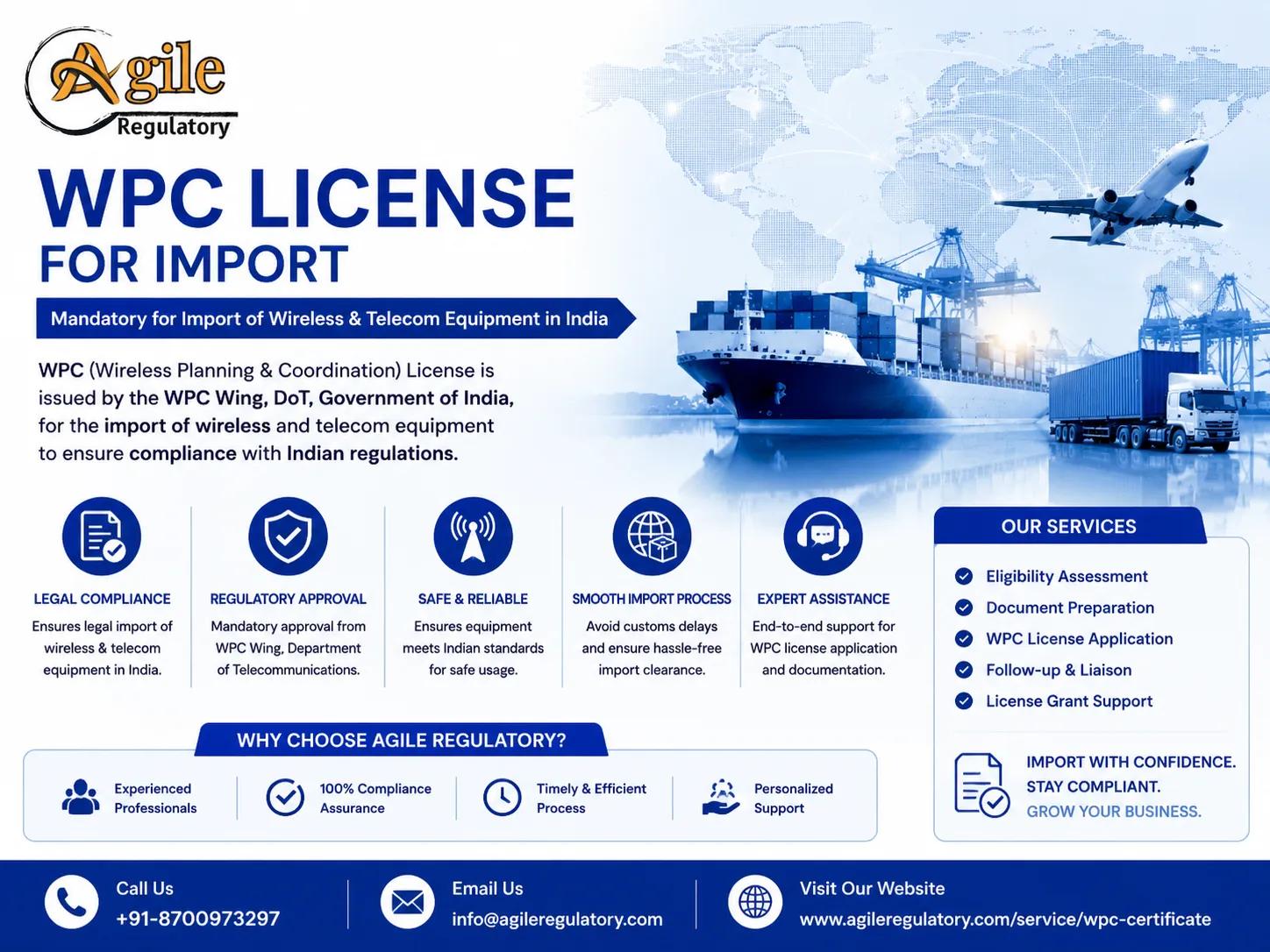
Wireless technology has transformed the way consumers and businesses communicate, connect, and operate. From smartphones and Bluetooth accessories to Wi-Fi equipment and IoT products, radio-frequency-enabled devices are now part of everyday commerce. However, businesses importing or marketing such products in India must evaluate whether specific wireless regulatory approvals are required before the equipment enters the market.
The WPC License is a commonly searched term for approvals associated with wireless equipment in India. The Wireless Planning & Coordination (WPC) Wing of the Department of Telecommunications (DoT) is responsible for important aspects of wireless frequency management and related authorisations.
Understanding the difference between WPC ETA, import permissions, and other wireless authorisations is essential for businesses because the applicable requirement depends on the product, frequency, technical specifications, and intended use.
What Is a WPC License?
WPC is the Wireless Planning & Coordination Wing under the Department of Telecommunications. It deals with spectrum planning, frequency allocation, and regulatory matters concerning wireless equipment and radio-frequency use.
The expression WPC License is often used broadly, but there is no single licence applicable to every wireless product.
Depending on the equipment and activity, an applicant may need:
Equipment Type Approval (ETA)
Wireless equipment import permission
Radio equipment possession-related authorisation
Frequency or spectrum-related permission
Other applicable DoT authorisations
Therefore, businesses should identify the exact approval before beginning the application process.
Why Is WPC Certification Important?
Wireless equipment operates on radio frequencies. If devices operate outside permitted parameters, they can potentially interfere with other communication systems.
WPC-related certification and authorisation help ensure that applicable wireless equipment meets the technical and regulatory conditions prescribed for its operation.
Businesses dealing with products such as Bluetooth, Wi-Fi, short-range wireless, and other RF-enabled devices should assess WPC requirements before importing or selling them.
WPC Certification Mandatory Products
There is no single list in which every electronic product automatically requires the same WPC approval. Instead, applicability depends on the product's wireless functionality and technical parameters.
Products that may require assessment include:
Bluetooth headphones and earphones
Wireless speakers
Smartwatches
Wi-Fi routers and access points
Wireless microphones
IoT equipment
Certain smart home devices
Wireless networking products
Connected cameras
Other short-range wireless devices
The operating frequency, RF power, technology, and intended use should be examined before deciding which approval is applicable.
What Is WPC ETA Certificate?
A WPC ETA certificate refers to Equipment Type Approval for eligible wireless equipment.
ETA is particularly relevant for finished products using radio-frequency technologies in permitted or de-licensed frequency bands, subject to applicable conditions.
The approval process generally focuses on the technical characteristics of the wireless equipment and whether the device conforms to the applicable Indian requirements.
Depending on the product, an ETA route can be relevant for devices such as:
Bluetooth products
Wi-Fi-enabled devices
Wireless microphones
Smartwatches
Speakers
Headphones
Certain IoT products
Other short-range wireless equipment
Products involving restricted frequencies or specialised applications may follow a different regulatory route.
WPC Certification Process
The WPC certification process should begin with technical assessment rather than simply collecting generic company documents.
Step 1: Identify the Product
Determine the exact product model, manufacturer, wireless technology, and intended use.
Step 2: Review RF Specifications
Examine the frequency range, bandwidth, output power, modulation, antenna details, and other relevant technical parameters.
Step 3: Determine the Approval Route
Assess whether the product requires ETA, import permission, possession authorisation, or another applicable DoT approval.
Step 4: Prepare Technical Documents
Depending on the route, documents can include RF test reports, technical literature, manufacturer authorisation, product specifications, and other supporting records.
Step 5: Submit the Application
Complete the applicable online application through the designated DoT/WPC system.
Step 6: Regulatory Verification
The submitted information and supporting documents may be examined by the relevant authority.
Step 7: Receive the Approval
After the applicable requirements are fulfilled, the relevant certificate or authorisation is issued.
WPC Import Requirements
Businesses involved in WPC import activities should determine regulatory requirements before placing an international order.
The fact that a product contains Bluetooth or Wi-Fi does not by itself determine the exact approval. The importer should examine the product's wireless specifications and identify whether an ETA, import permission, or another authorisation is required.
Early assessment can help reduce the risk of shipments being delayed because of missing regulatory documentation.
WPC Import Licence vs ETA
A common mistake is treating an ETA as an import licence.
The two can have different regulatory purposes.
An ETA generally concerns the technical approval of eligible wireless equipment, whereas an import licence or authorisation may relate to permission for importing specific wireless or radio equipment under applicable rules.
The correct requirement depends on the equipment and intended activity.
WPC ETA Registration
Businesses seeking WPC ETA registration should first confirm that their product falls within the eligible ETA route.
The technical documentation is then prepared based on the product's wireless characteristics. For eligible products, the applicable self-declaration process can be used where permitted.
The ETA route can simplify compliance for qualifying finished products, but it does not mean every wireless device is automatically eligible.
Specialised equipment such as radar, jamming equipment, satellite-related systems, and certain other restricted wireless applications can be subject to different requirements.
WPC Certificate in Ghaziabad
Businesses searching for a WPC certificate in Ghaziabad should understand that WPC is a central regulatory framework under the Department of Telecommunications.
There is generally not a separate Ghaziabad-specific WPC certification system. Businesses located in Ghaziabad, Noida, or elsewhere in Uttar Pradesh follow the applicable national requirements.
However, businesses may have additional local, state, customs, or product-specific compliances depending on their operations.
How WPC and Other Certifications Work Together
Wireless products can sometimes require more than one regulatory approval.
For example, a product may have WPC-related requirements because it uses radio frequencies while separately falling under BIS requirements because of its product category.
Similarly, importers may need:
IEC
Customs documentation
GST-related documentation
BIS certification or registration, where applicable
WPC approval
Product-specific permissions
Manufacturer authorisation
Technical test reports
Each approval addresses a different compliance area, so one certificate should not be assumed to replace another.
Benefits of Professional WPC Assistance
The technical nature of wireless approvals can make the process difficult for businesses unfamiliar with RF documentation and regulatory terminology.
A professional compliance consultant can assist with:
Product applicability assessment
Document preparation
RF report review
Application support
Manufacturer documentation
Import compliance
Clarification of ETA and licence requirements
Follow-up during the approval process
This can be particularly useful for importers handling multiple products or products sourced from overseas manufacturers.
How Agile Regulatory Can Help
Agile Regulatory provides regulatory compliance support for businesses dealing with wireless and imported electronic products.
Our assistance can cover product assessment, documentation, WPC ETA-related applications, import compliance, and coordination of applicable regulatory requirements.
Instead of treating every product as requiring the same certificate, the process focuses on identifying the actual wireless characteristics and applicable approval route.
This helps businesses prepare more accurately before importing or commercialising their products in India.
Conclusion
Wireless products are becoming increasingly important across consumer electronics, telecommunications, smart devices, and industrial applications. With this growth comes the need to understand India’s wireless regulatory framework.
The WPC License is commonly used as a broad term, but the actual approval required depends on the product, frequency, technology, and intended activity. WPC ETA, import licences, and other authorisations should therefore be distinguished carefully.
Businesses planning WPC import activities should assess their products before shipment, verify technical documentation, and determine the correct regulatory route. With proper preparation and professional compliance support, importers can reduce documentation errors and build a smoother regulatory process.
Frequently Asked Questions
1. What is a WPC License in India?
WPC License is a commonly used term for approvals and authorisations associated with wireless equipment under the Department of Telecommunications. The exact approval depends on the product and activity.
2. What products require WPC certification?
Products using wireless or radio-frequency technology may require WPC assessment. Examples include certain Bluetooth, Wi-Fi, IoT, wireless networking, and short-range communication devices.
3. What is a WPC ETA certificate?
A WPC ETA certificate is Equipment Type Approval for eligible wireless equipment meeting the applicable technical and frequency requirements.
4. Is WPC ETA the same as an import licence?
No. ETA and an import licence can have different purposes. The applicable requirement depends on the product and intended activity.
5. How does WPC ETA registration work?
The applicant generally identifies the product, reviews its RF parameters, prepares technical documentation, submits the applicable application, and completes the relevant regulatory process.
6. Is WPC certification mandatory for every electronic product?
No. WPC requirements generally depend on whether the equipment uses wireless or radio-frequency technology and whether a specific approval is applicable.
7. Do imported Bluetooth products require WPC approval?
Some Bluetooth products can fall under applicable ETA or other WPC requirements. The exact route should be determined from the product's technical specifications.
8. Is there a separate WPC certificate for Ghaziabad?
WPC is governed through the central telecommunications framework. Businesses in Ghaziabad generally follow the applicable national requirements rather than a separate city-level WPC certification system.
9. Can WPC approval be required along with BIS certification?
Yes. Depending on the product, separate WPC and BIS requirements may apply because they address different regulatory aspects.
10. When should WPC compliance be checked for imports?
WPC requirements should ideally be assessed before the product is shipped to India so that the necessary approval or authorisation can be arranged in advance.